Wednesday, December 22, 2010

Getting the Holidays Right

Francis and Julia Rocchi, Christmas, c. 1989

My wife, Marie, and I always tried to de-emphasize the gift-giving aspects of Christmas in favor of the spiritual side and the importance of family. One year, my daughter innocently and inadvertently taught me that we were heading in the right direction.
We lived in upstate New York at the time. A few short days before Christmas, I had to make a run to the mall to pick up some last-minute gifts. There was much to do. We had pageants, Mass and other activities at our church, school and community. We would spend Christmas Day together, just the four of us. Then we would hit the road to be with our families back in Philadelphia. I had very little time that day, but I was able to spare a hour or two to get some final items. I grabbed my daughter Julia, about 7, and we were off.
The mall was amazingly quiet given that it was just before Christmas. Luckily, that allowed me to get what I needed. Julia asked if she could see Santa Claus. Since we had time to spare, it was no problem.
I let her go, and she had Santa all to herself. I observed from a distance, and I could see that she was quite animated, really chatting up the old man, so I could only imagine what kind of booty she wanted for Christmas.
When I went to retrieve her, she went off to see some decorations. I asked Santa privately, out of her earshot, what she asked him for.
"Oh, she didn't ask for anything," he said.
I was taken aback. "She sat with you a long time. What was she talking about?"
"She was telling me all about how you were going to church tonight, how you were going to be together for Christmas and then travel to be with family. Most kids spend their times telling me about what they want. But she was totally focused on family."
Hm. I guess Marie and I got it right that year.
I have been reminded of that story every Christmas since because, I'm sorry to say, our view of the holiday is looking more and more unusual. To say it is about gifts is a cliche. To say that we don't keep Christ in Christmas is even more obvious. But in the end, I don't know if any of us know what this holiday means any more. Perhaps it has come to mean nothing.
When I turn on the television, I see so many images that are unrelated and even random. There are saccharine movies on Showtime or The Hallmark Channel. Cartoon specials about Rudolph the Red-Nosed Reindeer, Frosty the Snowman and The Polar Express. They all add up to...

Nothing in particular. In the end, they do not comprise a unifying image of Christmas. The radio is just as bad, with songs about lists of things that kids want, grown-up lists of things we want, a seductress that wants cash from Kris Kringle, and people being blue because someone they love is not with them for the holiday (Merry Christmas Darling, All I Want for Christmas is You, Blue Christmas, etc.). But why do these people want someone with them at this time of year? Either they don't need to say it out loud because we know intuitively, or they don't say it because they don't know themselves. Karen Carpenter sang that logs on the fire filled her with desire. But desire for what? Why bother?

However, during that one Christmas, our daughter (and later our son, Francis) showed us that we were able to cut through the Yuletide clutter. By taking them to church, singing "Happy Birthday" to Jesus, hearing religious music more than the secular, and showing them many more Nativity scenes than pictures of Santa, we have had a modicum of success in fighting a distinctly myopic view of the holiday. I only hope that we can do the same with other holidays. I like to remember that the Fourth of July and Memorial Day are not just long weekends, but were actually created to honor heroes. But I guess I'll take one battle at a time.

The end-of-year holidays can be significant to all of us, as most of us can find their roots in our individual cultures. I hope you find your own special meaning in these days, and I wish you all health and happiness in the new year.

Saturday, December 18, 2010

BAH! HUMBUG on all-Christmas radio!


I generally hate to add any negativity to this lovely season, but here goes...


I have come to hate all-Christmas radio broadcasting.


There, I said it. I have become a Christmas Crab on this subject. And believe me, I love Christmas. I sing it every year with my group, A Cappella Pops. I have more CDs than my family care for me to have, and I play them constantly. One of my biggest coups in life was getting a car with a multi-CD play that even scrambles the selections. Oh, Joy! Now I can have a wide variety of Christmas music playing during all of my drive time. (Add this to the long list of things that drive my wife nuts.)

However, my idea of Christmas music is not the same as radio programmers. To me, Christmas is about being with family, and believe it or not, I actually believe it is about celebrating the birth of Christ, the seed of the Christian faith. I believe this just as I regard Hanukkah as the remembrance of a miraculous victory rather than eight days of gift-giving.

Yes, I snap my fingers to Mariah Carey singing "All I Want for Christmas is You," but not once an hour. Once a week will do, thank you. And while I believe that the season is captured in the lovely "O Holy Night," I don't think the song was composed so that Celine Dion could pop several arteries proving she can hit the high note at the end.

Now the all-Christmas stations start their assault on Thanksgiving and stop sharp on midnight of Christmas Day. (By the way, people in Europe treat Christmas as a season, not a one-day event. Hello, the 12 days of Christmas? Anyone hear of that?) That's a long time to endure mind-numbingly bad music, such as "Do They Know It's Christmas," or "Grown-Up Christmas List." And please don't get me started on "Grandma Got Run Over by a Reindeer."

So, excuse me, Radio Programmers, I will pass on your secular selections until you show more awareness of what the season is all about. In the meantime, dear readers, I direct you to a performance of what I regard as one of the greatest Christmas songs of all time, In the First Light, as performed by Glad. Enjoy, and happy holidays.

Monday, December 6, 2010

SWIFT JUSTICE -- This Entertainer has Earned her Leading Status Through Careful, Consistent Image Management


Several years ago, a good friend who lives in the Reading, Pa., area had a visitor to his home. He and his son are both musicians, and a young female friend of the son came to their home. "Would you like to listen to my music?," she asked. "I wrote some songs, and I'd like to play them for you."
He listened, and yes, they were pretty good songs. He also liked the young lady, thinking she was sweet and polite.
A few years later, her parents took a huge leap of faith and moved from Pennsylvania to Nashville to support her dream of being a songwriter. It paid off big, for their daughter, for themselves and for all of us.
The title of this post and the accompanying photo tip my hand, I'm sure. Yes, the young lady in question is Taylor Swift, who has just been named by Entertainment Weekly magazine as the Entertainer of the Year.
I cannot imagine anyone more deserving. Think of her accomplishments in the past year alone: A Grammy for Best Album of the Year, and three more in a variety of categories. A new album, Speak Now, which sold more than a million copies in its first week (PLATINUM IN ONE WEEK!) and for which she wrote all the songs. An appearance in a hit movie, Valentine's Day. Hosting Saturday Night Live, and showing herself to be a pretty capable sketch comedian. A successful tour. Surviving and even deftly handling a zeitgeist moment when rapper Kanye West publicly dissed her at the MTV Video Awards, calling Swift unworthy of her trophy when compared to Beyonce.
Most people view the world through their own prism, and mine tends to communication and marketing. What amazes me most about this artist is the consistency of her vision and her subtle self-confidence. This is most evident in her careful stewardship of her own image and messaging, staying calm in every situation.
Would you argue that she owes that to her handlers? I don't. She stood on that stage alone at the MTV Awards when West dishonored her, and she handled the situation with more grace and restraint than we have the right to expect from a 20-year-old. Also, I was impressed by her calm control during her in the course of her interview with EW. Her expressions were articulate, her words as well-chosen as you would hope from a successful songwriter. She diminished the interviewer's suggestion from others that she saved the music business: "I write music about my life and love and relationships, and...(t)hat's where I have to draw the line as far as what I am and what I am not."
The interviewer also asked how she felt about being linked to Kanye West. She replied, "The one choice that I do have, that I continue to make, is to not talk about it."
The interviewer next asked if she had heard his new record. Underlining her point, she simply replied, "I don't want to talk about him."
End of story. Point well made, Ms. Swift.
I don't own one of her albums, although I listen to her and catch her on the tube when I can. (Let's get real; I'm not part of her target demographic.) But I look forward to watching her grow as an artist and a cultural force. I dare say she is off to an astounding start.

Monday, November 29, 2010

We Need Leslie Nielsen, a Hero for These Challenging Times


Okay, so I was in an airport in Boston maybe 30 years ago, waiting for my plane. I had gone for a job interview, and when it was over, I called my wife, Marie, and told her how it went.
When I got off the phone, I was wandering the concourse when I looked over and saw a crowd of people staring at a man who was sitting alone. He was tall, grey-haired and pretty handsome. It was Leslie Nielsen, star of the movie Airplane! and the TV show Police Squad.
People were just looking at him, poking each other and not doing anything in particular. But no one was talking to him. I thought What the Hell, and I walked up to him and stuck out my hand.
"Mr. Nielsen, I know you have no idea who I am, but my name is Pat Rocchi, and I just wanted to tell you how much I enjoy your movies and how much pleasure you have brought into my life."
He was taken aback at this. I don't know if it was the audacity I had to just walk up to him and tell him how much I liked him or if it was the frank admiration of his work. He gathered himself for a moment before he rose and said, "Well, thank you; thank you very much.'
He paused for a moment and, groping for something to say, he told me, "You know we have a new Police Squad movie coming out." He was referring to his then-upcoming film, The Naked Gun.
Being a movie buff and a fan of the TV show, I was aware that it had been in production. "Yes, I was aware that you were working on it. How is it?" (Such a small-talk thing to say, as though he would respond with, "It sucks. Don't go see it.")
His eyes lit up. "It's very funny, very funny. I think you'll enjoy it." In fact, I did. It is still none of my favorite comic movies of all time, just for the sheer silliness of it.
I had to ask him about his foray into comedy at a later part in his career. "Mr. Nielsen, I remember you as the Swamp Fox (an old Disney show about the American rebel, Francis Marion), and you were always so upright and serious. How do you like this new role in comedy?"
With that, he broke into a big, broad, absolutely sincere smile. "I love it," he said, quickly adding with a sly wink, "I like being dumb and stupid for people!"
We exchanged a few more pleasantries and, not wishing to overstay my welcome, I shook his hand and thanked him for his time. But one thing disappointed me. "You know, I just got off the phone with my wife, and she is also a big fan. She will never believe I met you."
He thought for a moment and then said, "Well, let's see if we can convince her." With that, he reached into his pocket and pulled out a handful of change. I was thinking, "Will he give me a quarter, and I must tell Marie that it came from Leslie Nielsen?" But he poked around the objects from his pocket, and pulled out a lapel pin that was a replica of the badge he wore in his TV show, Police Squad. He handed it to me and said, "Here. Give that to your wife, and she will know that you met me."
I was incredulous, gratified and delighted, all at once. I shook his hand again, laughing, and said, "Well thank you very much, Mr. Nielsen. I will always treasure it."
And I have. Never more than I do today. I wear it occasionally to an event just as a conversation starter, and the story never fails to get a laugh, as well as some appreciation for Mr. Nielsen's graciousness that day. He really has given me a lot of enjoyment over the years through his work, but that little encounter with me, an average fan of no particular import, makes me remember him very specially. I'm glad we had him, and I will miss him. Thank goodness for the permanence of film and video.
By the way, if you can, I suggest you search for the six-episode series of Police Squad on video, either streaming or by purchasing the DVDs. As my personal friend Leslie Neilsen told me, "It's very funny, very funny."
Leslie Nielsen died on Sunday, November 29, 2010, in Fort Lauderdale, Fla., of complications from pneumonia. He was 84 years old.

Sunday, November 28, 2010

127 Hours -- More Than a Disarming Film


Many years, someone I knew who had seen The Deer Hunter, Michael Cimino's Oscar-winning film allegory on Vietnam, was asked what it was about. "Oh, it's about a soldier who blows his brains out," was the succinct reply.


Well, actually no, The Deer Hunter was about much more than that, if one cared to analyze it beyond the obvious. But many films over the years have become known for a single aspect or scene (think "Bob&Carol&Ted&Alice" or "Portnoy's Complaint"), overlooking the work's deeper attributes.

There is a similar shorthand about a film currently on the local screens. Danny Boyle's 127 Hours tells the story of Aron Ralston (shown above), an adventurous hiker and outdoorsman whose arm is pinned between a canyon wall and a rock. He is trapped there for several days until he rescues himself in a most agonizing, courageous and unthinkable way.

I will skip the obvious story detail for now. I want to tell you instead about how the film begins, with Ralston's hurried exit from his job and his home to go off into his own little world, the outside world of rocks and trails and pools of water. In this beginning, Ralston encounters a couple of young women hiking the same Utah rock formations that he is. Ralston introduces them to a shimmering underground pool that they would not have found without him. Yes, this is Aron's world, a world that exists only in the exterior. The pool is cool and deep. Aron, on the other hand, appears to be quite shallow.

Soon after leaving the girls, Aron fins himself in his dilemma. He climbs into a deep crevice. He first tests the footing of a rock at the entrance. It seems secure under his feet -- after all, as he had observed earlier, these rocks had been there for millions of years. But as the poet Robert Burns noted, the best-laid plans of mice, men and climbers gang aft agley. The rock falls into the crevice and improbably traps him against the wall by his arm. He is stuck there for days, facing a seemingly certain death, until he frees himself by cutting off his arm -- as it turns out, ingeniously so -- with a painfully dull knife.
This is the plot turn that everyone seems to know. However, if you go to see this film -- and I heartily recommend that you do -- jus for this spectacle, you may overlook the real genius of Danny Boyle's film-making. Boyle's masterpiece and best-known work, Slumdog Millionaire, took viewers on a breakneck view of life in the slums of India. In 127 Hours, Boyle instead takes us on an inward journey of a man who had focused only on the Great Outwards. With his subject confined to a single space, the camera and the screenplay are forced to look at Ralston and his somewhat self-made jail. We learn from Ralston's ruminations about how he has neglected others in his life: The mother whose phone message he ignored. The ex-girlfriend who presciently said that he would be a lonely man one day. The co-worker who was only a blip on Ralston's self-absorbed radar. Ironically, his self-centeredness helped trap him, as other people may have known where he was if he had only reached out to them.
Ever-resourceful, Ralston uses his tools to survive and perhaps even document his ordeal. He records his travails on his video camera, creating a message to his parents, telling them (perhaps for the first time?), that he loves them, just in cse he doesn't survive this ordeal. He scratches his name on the canyon wall, perhaps believing that he would indeed escape this situation.
The smallest conveniences become a treat for him. He comes to appreciate a daily 15-minute does of sunshine on his leg as though he is feeling it for the first time. He looks forward to the daily flight path of an eagle, one of his few companions even over his head. All of these reactions are captured in James Franco's nuanced portrayal of Ralston, a performance that is a revelation of this talented young actor.
But when he rewinds his video camera, Ralston gets a glimpse of what he may have been missing in his life. The girls left a message for him at the pool on his video camera, and he learns that they could see through him almost as soon as they met him. It is an insight he himself has never had.
The actual escape scene is enthralling. Yes, many of us have heard that people fainted in theaters at the sight of Ralston's amputation. However, it is entirely tasteful and artful. Through the use of prosthetics and the craft of film-making (the sound of Ralston's escape may shock you more than the sight of it), Boyle tells you all you need to know about the amputation.
Roger Ebert in his own review that 127 Hours is "an exercise in conquering the unfilmable." That is true in so many ways. While Boyle captures the vast beauty of the expanses of Utah, he also narrows his focus to the small space that Aron Ralston occupies, and then goes even more deeply into the soul of a troubled man who finds his way out of more than one confinement. It is a breath-taking cinematic achievement.

Friday, November 26, 2010

Where Have I Been?


Wow! It's nearly two months since my last blog post. I have been beset mostly by overwork since then, and it raises a reverse important philosophical question: If a Blogger doesn't make a sound, is it because s/he got lost in the forest?
Seriously, I have been much more productive in my work in 2010, having help guide a health care organization through its messaging, contributed to a hospital system's accreditation application, served as COO of my acappella singing group, and in the course of all this, I produced ONE QUARTER of the posts that I did in the previous year. Does this mean I have less to say, and therefore less to contribute?
I have to admit that the answer is yes. Put simply, I am not thinking as much as I had. I have reflected less on all the issues that surround all of us. Oh, some things bubbled to the surface. I was absolutely outraged by the way Andrew Breitbart ambushed Shirley Sherrod. The mid-term elections were shameful in their cacophony, and the bullying of gays and others upset me very much, as it reminded us of how defenseless we all may be. But mostly, I was too preoccupied to feel that I had much to contribute.
I also forgot the mantra for all writers: ALWAYS BE WRITING! I had lost my discipline (or my energy?) to put something, ANYthing down on paper or the ether just to stay in the practice of writing. Sure, I was doing that for my clients, but not for you, dear friends, and I missed it. (I HOPE you also missed me.)
I promise that 2011 will be different. I have a few things on my docket that will give me the opportunity to stay in touch. For example, I hope to finish my second book in the new year, and that will be on organizational communication. Second, 2011 is the centenary of Marshall MacLuhan, probably the greatest communication philosopher of all time. I intend to honor him throughout the year.
Finally, I plan to return to Italy to visit my family. That means brushing up on my Italian, which I learned only a few years ago (and even then, I was speaking on an elementary level). That should contain more than enough fodder on communication.
In retrospect, I am happier that I didn't just babble on these last few months just for the sake of writing. I believe that I will have much more to say that is worthwhile.
Just promise you'll let me know if I'm incorrect. ;-)

Monday, September 27, 2010

A Voice for All Seasons

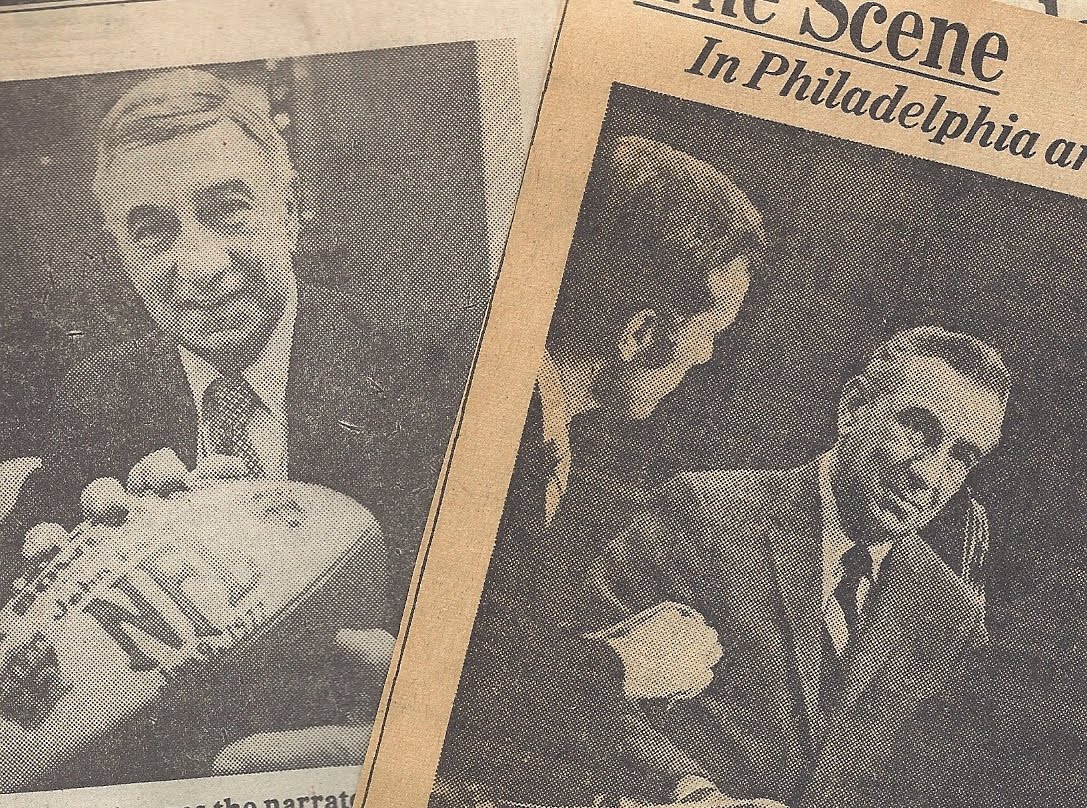
The clippings from 26 years ago -- a long-ago September 27 -- are yellowed, but the memories remain vivid. The headline announced:
"John Facenda dies; eminent anchorman."
There are people, though they age, are of a unique class and so we can't imagine life without them. For lifelong Philadelphians like me, John Facenda was such a man. If you are reading this in Philadelphia, you must remember that John Facenda was the very model of a newsman. Honest. Reliable. Most of all, believable, as in "trustworthy" rather than merely "persuasive," as you might be fooled into thinking a disingenuous person is credible. Put another way, Mr. Facenda was to Philadelphia what Walter Cronkite was to the entire nation. As local writer Clark DeLeon wrote in his tribute to Mr. Facenda 26 years ago, "He brought a dignity to the (broadcasting) industry in its infancy, a dignity we can appreciate better now (at the time of his passing) that we can hardly remember their names six months later."
Has so little really changed in those ensuing 26 years? It seems so. It seems we still have many more Keith Obermanns and Bill O'Reillys and fewer Ed Murrows; more Contessa Brewers and fewer Katherine Grahams.
If you are reading this across the nation, you probably know Mr. Facenda as the first narrator of NFL Films. It is a cliche to say that he was known as "the voice of God." Yet the sobriquet sticks, because no one has come along to supplant him. Indeed, he has proved to be irreplaceable. Legend has it that one night in 1965, Mr. Facenda was watching the slow-motion game sequences on the TV, where happened to be produced by NFL Films, a local firm near Philadelphia. Mr. Facenda was rhapsodizing just how beautiful the visuals were, and he started to improvise narration to go with it.
Ed Sabol, founder of NFL Films, happened to be at the bar. Mr. Facenda recalled that Sabol came up to him and said, "If I give you a script, could you repeat what you just did?"
Mr. Facenda said he would try. And so began his association with NFL Films, which would end 19 years later with his death.
(Witness this example in is this clip in which he pays homage to "The Quarterback.")
I was privileged to know John Facenda and work with him. As a communications student at Temple University, I interned at WCAU-TV, Mr. Facenda's station. I worked with him on "Sunday Edition," a local public affairs program. He was unfailingly courtly and always professional. Just hearing him say hello was like listening to a symphony of the voice. He was magnificent. But I must admit that I related to him as a fellow Italian American. In those days, our people did not always have positive role models, especially in the media. Most portrayals of Italians consisted of thick-tongued thugs in gangster movies. But Mr. Facenda represented the best of us who appreciate language, especially the English language that his father drilled into him and his siblings with flash cards around the kitchen table. It was there he learned his elocution that served him so well.
This begged an inevitable question from me. "John," I was once asked him, "you came into the business when everyone's name was homogenized. But you kept your ethnic name. Were you ever asked to change it?"
His eyes flared and his demeanor changed to one I had never seen. "Yes, Pat, they DID want me to change my name." His usually controlled voice began to rise in indignation over a long-ago insult that was suddenly remembered. "They want me to change my name to John Foster. John Foster! Can you imagine that, Pat? And that's when I told them in no uncertain terms to go fuck themselves!"
My jaw dropped. I had never heard John say "damn" or "hell," so the F-bomb was unimaginable. But that was indicative of his pride in his Italian heritage. My own first name is Pasquale, and though I use "Pat" for the ease of pronunciation, I never shrink from acknowledging my real name. So Mr. Facenda's own pride struck a chord that resonates
with me today.
In the 26 years since he departed us, I think of him
often. I remember him as a nobly professional co-worker who gave magic to whatever feeble words this callow young man gave him to say. I remember him as the authoritative voice who ruled, first, the local airwaves and, later, the cinematic gridiron. But most of all, I remember his avuncular warmth, which came through the image orthicon tubes that sat in countless Philadelphia homes. He ended every broadcast with his signature sign-off: "Have a nice night tonight and a good day tomorrow. Goodnight, all."
Think of him whenever you see local and national anchors missing cues and inserting themselves into the news they are covering. Then think about just how much we have lost over the last 26 years, and probably for ever more.

Thursday, September 16, 2010

Honoring a Word Warrior

As a communicator, author and overall lover of language, I pause to honor the life and legacy of Edwin Newman.The NBC newscaster and author passed on August 13 in Oxford, England -- a suitably academic ambiance for such a learned man, though on the other hand, he may have found it a stuffy setting.
Mr. Newman seemed to have lived two famous lives. One was the award-winning broadcaster who was often called on to deliver sad news with the gravity it deserved. Examples were the assassinations of President Kennedy (on radio) and Rev. Martin Luther King (on television).
The other was as the guardian of sound speech. He was the grammatical gadfly who spent much time and effort reminding us of the value of the proper use of language.
While I looked to him as a role model as I prepared for a career in broadcasting, it was really his crusade for clear language that caught my attention. His two most famous books, Strictly Speaking and A Civil Tongue,
were published in 1974 and 1976, respectively. It may be hard to imagine, but they really got U.S. citizens to discuss their language. (The subtitle of Strictly Speaking was "Will America be the death of English?")
The Philadelphia Bulletin called it "a mighty important book. (Newman) spares no one in criticizing the poor way we speak and write." The Chicago Tribune called it "relentlessly funny."
True and true. But the books were also social phenomena of their times. Talk shows were devoting entire episodes to this subject. I remember one lively panel discussion on The Tomorrow Show with Tom Snyder. I know it featured a really good panel, although the only person I remember 35 years later was Abe Burrows, lyricist for Guys and Dolls and other Broadway shows. I remember Burroughs said that once you could tell someone that their work was "pretty good," and that was a real compliment. By the mid-1970s, it was damning with faint praise to say someone was pretty good. So Burroughs observed the word inflation that plagues us still today. (A side note: How do we give someone proper praise when a standing ovation is standard for such non-luminaries as the judges on American Idol?" Just asking....)
I also learned that night that linguists could find an inverse link between the decline of German literature and the rise of Nazism. Observe the state of political discourse in this country, and I will dare you not to be discouraged.
Other people have made more fatuous observations on our use and misuse of language. The great George Carlin liked to joke about oxymora such as"jumbo shrimp" and "military intelligence." But Newman was actually more trenchant, identifying ridiculous, everyday phrases that people would take for granted. Like the store that trumpets "discounts of up to 40 percent...AND MORE!" Or when a sportscaster praises an up-and-coming running back by saying "he has a great future in front of him."
Mr. Newman's work influenced me profoundly. Not only did I start to notice wasteful language more and more, but I cleaned up my own writing. One piece of evidence of this was when my comprehensive exams for my master's degree was graded "with distinction." Curious, I asked the head of the department what was so special about what I turned in. H
e responded without hesitation, "Pat, I could read your blue book, and I knew exactly what you were trying to say."
Credit Mr. Newman for that. And I will also credit him for raising the overall standards of American English. As an editor in the corporate world and academia, I see a real improvement in the ways most people express themselves compared to years ago. Documents are more clearly written and not so laden with jargon. I see less bloat, more concision. Also, most corporate speakers are pretty competent, where the opposite used to be the rule.
I thought of Edwin Newman frequently over the years. He had faded from the public eye, but since I had not heard of his death, I had faith that he was still healthy. Still, his obituary this morning struck me with force. But in the end, I took satisfaction in knowing that he had endured (91 years old). I hope that his long life allowed him to see that he was a positive influence on our writing and speaking. I know he was such a force in mine.
I suggest that you treat yourself by picking up one of Edwin Newman's books. I guarantee that you won't be disappointed.

Saturday, August 28, 2010

"Rethinking Home Ownership," Credit Card Update Challenge, Illuminate Us

Two items I read this week have made our current economy more clear to me, and it points out our collective culpability for the situation.
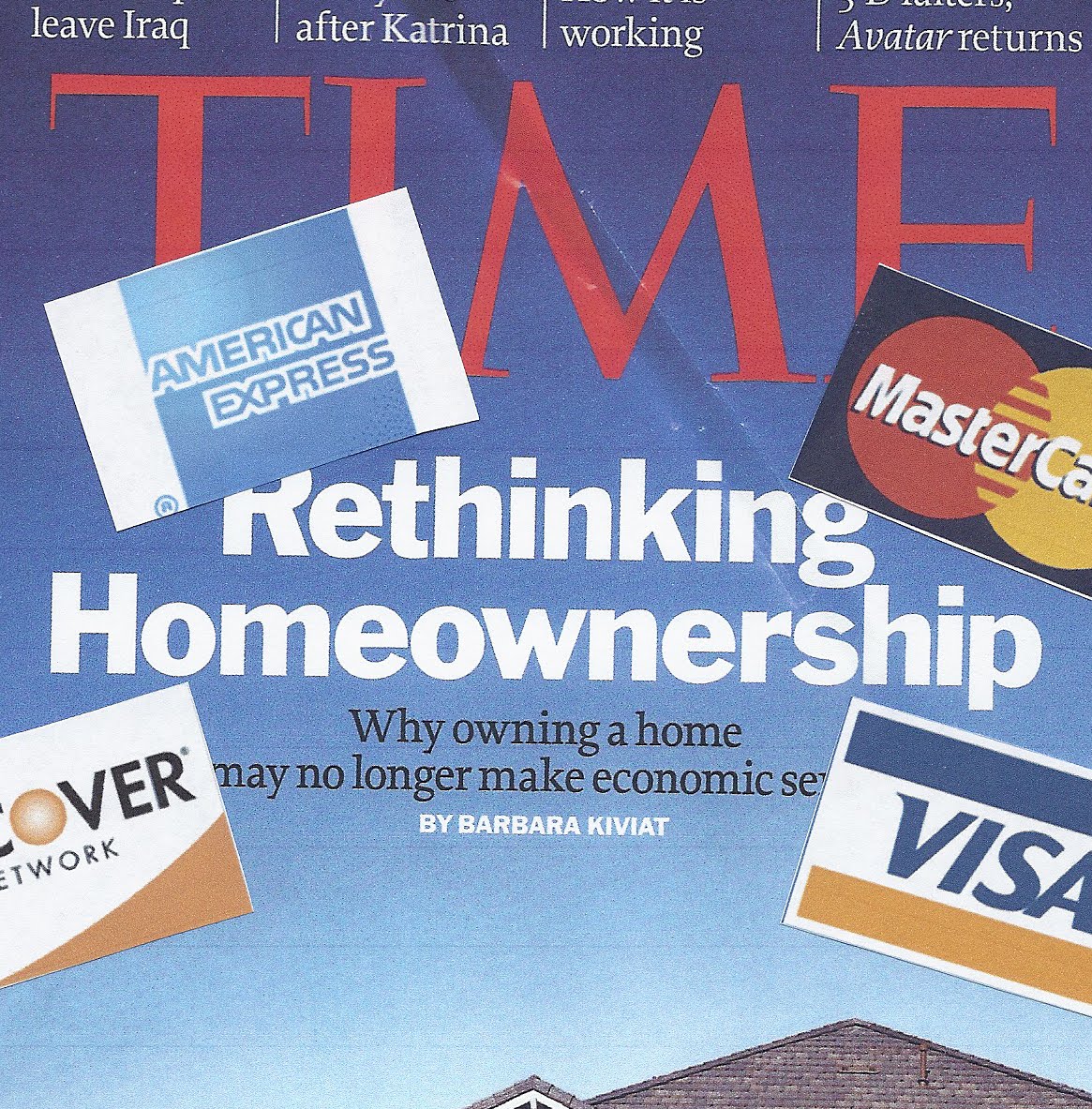
In trying to figure out which is the chicken and which is the egg, let me begin with the cover story of the September 6 issue of TIME magazine, titled "Rethinking Homeownership," by Barbara Kiviat. Kiviat has covered business and economics for TIME for about eight years. She has long been an outspoken critic of the tax credits for home owners, and she's taken particular aim at the credits initiated by the Obama administration in November 2009.
Here is a link to the article. I encourage you to read it in its entirety. I hit some high points below, but no synopsis can do it justice.
  1. While we take for granted that homeownership is an integral part of America, the U.S. government did not start instituting policies that supported homeowners until the 20th century. That was when Secretary of Commerce Herbert Hoover stated that "maintaining a high percentage of individual homeowners is one of the searching tests that now challenge the people of the United States."
  2. In 1986, the tax code was rewritten to eliminate the deduction of interest from consumer loans, such as credit card debt. However, an exception was made for the interest paid on a mortgage, and this allowance has cost the government about $80 billion in lost revenue.
  3. It was the failure of Fannie Mae and Freddie Mac, the agencies help keep mortgage rates low, that needed a $150 billion bailout. Additionally, it is our blind allegiance to the benefits of homeownership that, in part, led 11 million current owners to now owe more on their mortgages than their houses are worth.
  4. In this economy, mortgages can actually be a burden. When homeowners lose their jobs, their mobility to a new position can be limited, as they are tied to the financial capital that is tied up in their houses. This is especially pertinent when the homeowners' mortgage are under water.
  5. The economic advantages to a community or nation of home ownership are greatly exaggerated. There are many vibrant economies in communities that have lower homeownership. It is the same story internationally. In Switzerland, one of the world's richest nations (GDP per capita: $73,798), two-thirds of the citizens rent. In Spain, with per capita GDP of less than $35,000, homeownership is near 90 percent. Where is the quid pro quo?
  6. Homeownership enabled access to cheap credit, which masked fundamental foundational changes in the U.S. Kiviat writes, "For decades, income inequality has been growing, and middle-class wages have been stagnant. In the eyes of at least some academic observers, cheap credit, especially when used to buy ever-larger houses, has been a way to get people to feel O.K. with their lot....Pumped up on credit-card debt and home-equity loans, we kept spending away and felt richer than we actually were.
Switch now to a report from the Associated Press that credit card debt has fallen to their lowest level in eight years. Card holders continue to pay off balances in this uncertain economy. The average combined debt for bank-issued credit cards fell to $4,951 in the three months ended June 30, down more than 13 percent from $5,719 in the same period a year earlier, according to credit-reporting agency TransUnion LLC.
What all this tells us is that we Americans had a party for many years, and today we are paying the bill. Money that could be used to pay for goods, such as autos, home furnishings, and electronics, are instead paying down down. At least in part, this contributes to the stalling of our economy, for until there is more demand for goods, there is less need for the people who make them, sell them, service them, or insure them. To blame one presidential administration or another -- either "the one who spent our money on a stimulus program" or "the one who looked the other way while financial leaders were running amok" -- is purely political and overlooks the fundamentals problems in our economy.
Hubert Humphrey once said "
We believe that to err is human. To blame it on someone else is politics." Many of us need to look into the mirror for our current state. Or in the words of that great philosopher, Pogo the Possum, "We have met the enemy, and he is us."