Monday, September 27, 2010

A Voice for All Seasons

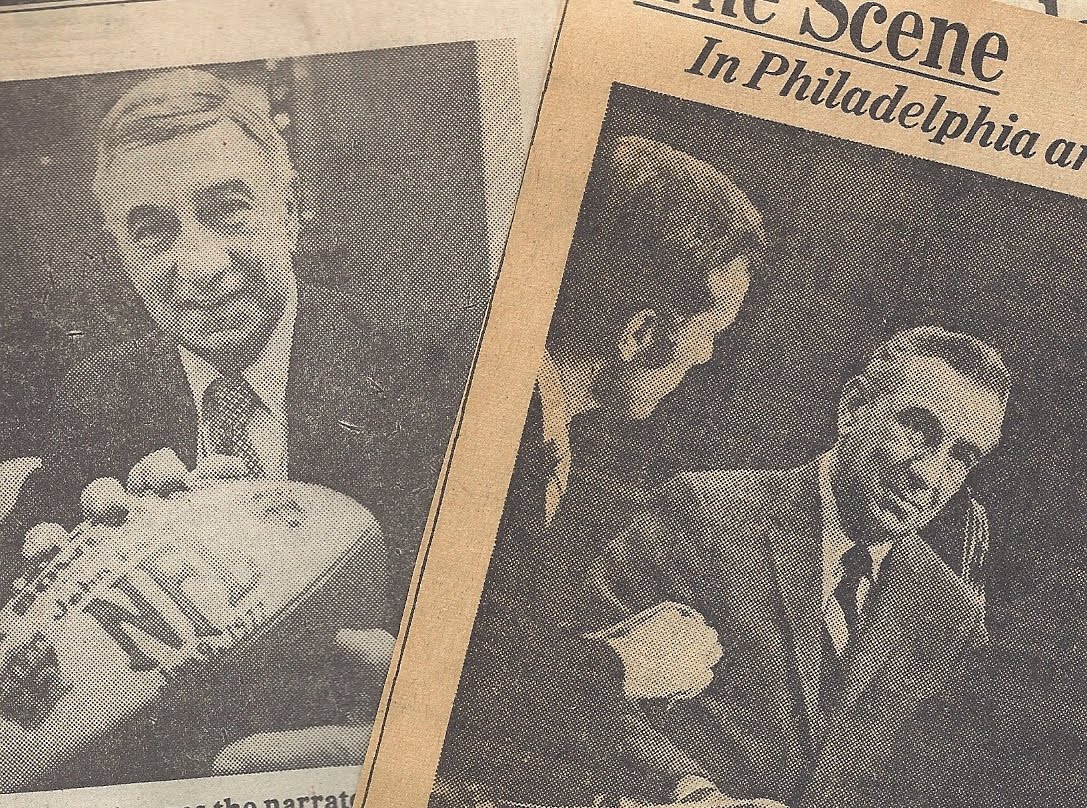
The clippings from 26 years ago -- a long-ago September 27 -- are yellowed, but the memories remain vivid. The headline announced:
"John Facenda dies; eminent anchorman."
There are people, though they age, are of a unique class and so we can't imagine life without them. For lifelong Philadelphians like me, John Facenda was such a man. If you are reading this in Philadelphia, you must remember that John Facenda was the very model of a newsman. Honest. Reliable. Most of all, believable, as in "trustworthy" rather than merely "persuasive," as you might be fooled into thinking a disingenuous person is credible. Put another way, Mr. Facenda was to Philadelphia what Walter Cronkite was to the entire nation. As local writer Clark DeLeon wrote in his tribute to Mr. Facenda 26 years ago, "He brought a dignity to the (broadcasting) industry in its infancy, a dignity we can appreciate better now (at the time of his passing) that we can hardly remember their names six months later."
Has so little really changed in those ensuing 26 years? It seems so. It seems we still have many more Keith Obermanns and Bill O'Reillys and fewer Ed Murrows; more Contessa Brewers and fewer Katherine Grahams.
If you are reading this across the nation, you probably know Mr. Facenda as the first narrator of NFL Films. It is a cliche to say that he was known as "the voice of God." Yet the sobriquet sticks, because no one has come along to supplant him. Indeed, he has proved to be irreplaceable. Legend has it that one night in 1965, Mr. Facenda was watching the slow-motion game sequences on the TV, where happened to be produced by NFL Films, a local firm near Philadelphia. Mr. Facenda was rhapsodizing just how beautiful the visuals were, and he started to improvise narration to go with it.
Ed Sabol, founder of NFL Films, happened to be at the bar. Mr. Facenda recalled that Sabol came up to him and said, "If I give you a script, could you repeat what you just did?"
Mr. Facenda said he would try. And so began his association with NFL Films, which would end 19 years later with his death.
(Witness this example in is this clip in which he pays homage to "The Quarterback.")
I was privileged to know John Facenda and work with him. As a communications student at Temple University, I interned at WCAU-TV, Mr. Facenda's station. I worked with him on "Sunday Edition," a local public affairs program. He was unfailingly courtly and always professional. Just hearing him say hello was like listening to a symphony of the voice. He was magnificent. But I must admit that I related to him as a fellow Italian American. In those days, our people did not always have positive role models, especially in the media. Most portrayals of Italians consisted of thick-tongued thugs in gangster movies. But Mr. Facenda represented the best of us who appreciate language, especially the English language that his father drilled into him and his siblings with flash cards around the kitchen table. It was there he learned his elocution that served him so well.
This begged an inevitable question from me. "John," I was once asked him, "you came into the business when everyone's name was homogenized. But you kept your ethnic name. Were you ever asked to change it?"
His eyes flared and his demeanor changed to one I had never seen. "Yes, Pat, they DID want me to change my name." His usually controlled voice began to rise in indignation over a long-ago insult that was suddenly remembered. "They want me to change my name to John Foster. John Foster! Can you imagine that, Pat? And that's when I told them in no uncertain terms to go fuck themselves!"
My jaw dropped. I had never heard John say "damn" or "hell," so the F-bomb was unimaginable. But that was indicative of his pride in his Italian heritage. My own first name is Pasquale, and though I use "Pat" for the ease of pronunciation, I never shrink from acknowledging my real name. So Mr. Facenda's own pride struck a chord that resonates
with me today.
In the 26 years since he departed us, I think of him
often. I remember him as a nobly professional co-worker who gave magic to whatever feeble words this callow young man gave him to say. I remember him as the authoritative voice who ruled, first, the local airwaves and, later, the cinematic gridiron. But most of all, I remember his avuncular warmth, which came through the image orthicon tubes that sat in countless Philadelphia homes. He ended every broadcast with his signature sign-off: "Have a nice night tonight and a good day tomorrow. Goodnight, all."
Think of him whenever you see local and national anchors missing cues and inserting themselves into the news they are covering. Then think about just how much we have lost over the last 26 years, and probably for ever more.

Thursday, September 16, 2010

Honoring a Word Warrior

As a communicator, author and overall lover of language, I pause to honor the life and legacy of Edwin Newman.The NBC newscaster and author passed on August 13 in Oxford, England -- a suitably academic ambiance for such a learned man, though on the other hand, he may have found it a stuffy setting.
Mr. Newman seemed to have lived two famous lives. One was the award-winning broadcaster who was often called on to deliver sad news with the gravity it deserved. Examples were the assassinations of President Kennedy (on radio) and Rev. Martin Luther King (on television).
The other was as the guardian of sound speech. He was the grammatical gadfly who spent much time and effort reminding us of the value of the proper use of language.
While I looked to him as a role model as I prepared for a career in broadcasting, it was really his crusade for clear language that caught my attention. His two most famous books, Strictly Speaking and A Civil Tongue,
were published in 1974 and 1976, respectively. It may be hard to imagine, but they really got U.S. citizens to discuss their language. (The subtitle of Strictly Speaking was "Will America be the death of English?")
The Philadelphia Bulletin called it "a mighty important book. (Newman) spares no one in criticizing the poor way we speak and write." The Chicago Tribune called it "relentlessly funny."
True and true. But the books were also social phenomena of their times. Talk shows were devoting entire episodes to this subject. I remember one lively panel discussion on The Tomorrow Show with Tom Snyder. I know it featured a really good panel, although the only person I remember 35 years later was Abe Burrows, lyricist for Guys and Dolls and other Broadway shows. I remember Burroughs said that once you could tell someone that their work was "pretty good," and that was a real compliment. By the mid-1970s, it was damning with faint praise to say someone was pretty good. So Burroughs observed the word inflation that plagues us still today. (A side note: How do we give someone proper praise when a standing ovation is standard for such non-luminaries as the judges on American Idol?" Just asking....)
I also learned that night that linguists could find an inverse link between the decline of German literature and the rise of Nazism. Observe the state of political discourse in this country, and I will dare you not to be discouraged.
Other people have made more fatuous observations on our use and misuse of language. The great George Carlin liked to joke about oxymora such as"jumbo shrimp" and "military intelligence." But Newman was actually more trenchant, identifying ridiculous, everyday phrases that people would take for granted. Like the store that trumpets "discounts of up to 40 percent...AND MORE!" Or when a sportscaster praises an up-and-coming running back by saying "he has a great future in front of him."
Mr. Newman's work influenced me profoundly. Not only did I start to notice wasteful language more and more, but I cleaned up my own writing. One piece of evidence of this was when my comprehensive exams for my master's degree was graded "with distinction." Curious, I asked the head of the department what was so special about what I turned in. H
e responded without hesitation, "Pat, I could read your blue book, and I knew exactly what you were trying to say."
Credit Mr. Newman for that. And I will also credit him for raising the overall standards of American English. As an editor in the corporate world and academia, I see a real improvement in the ways most people express themselves compared to years ago. Documents are more clearly written and not so laden with jargon. I see less bloat, more concision. Also, most corporate speakers are pretty competent, where the opposite used to be the rule.
I thought of Edwin Newman frequently over the years. He had faded from the public eye, but since I had not heard of his death, I had faith that he was still healthy. Still, his obituary this morning struck me with force. But in the end, I took satisfaction in knowing that he had endured (91 years old). I hope that his long life allowed him to see that he was a positive influence on our writing and speaking. I know he was such a force in mine.
I suggest that you treat yourself by picking up one of Edwin Newman's books. I guarantee that you won't be disappointed.

Saturday, August 28, 2010

"Rethinking Home Ownership," Credit Card Update Challenge, Illuminate Us

Two items I read this week have made our current economy more clear to me, and it points out our collective culpability for the situation.
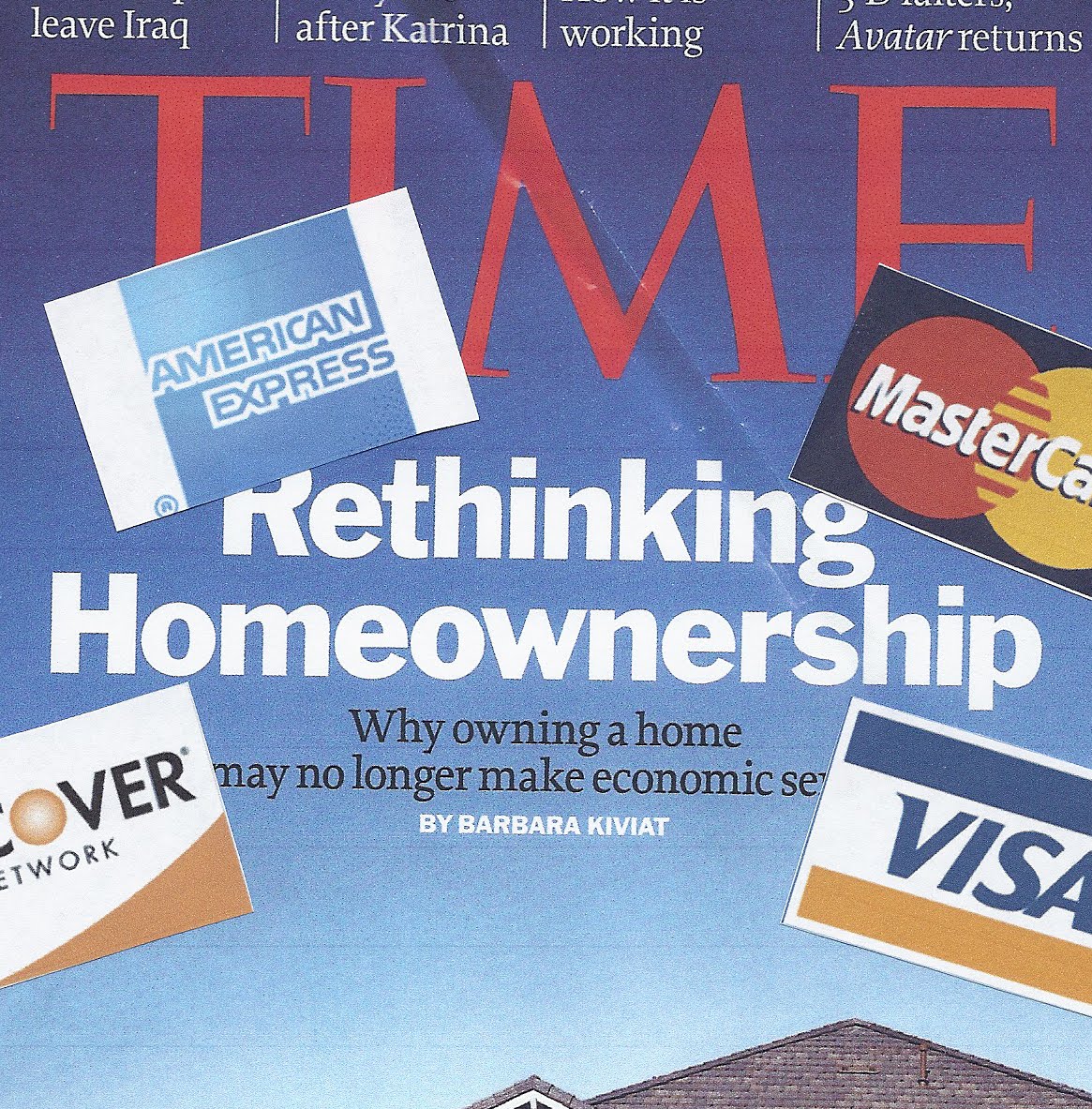
In trying to figure out which is the chicken and which is the egg, let me begin with the cover story of the September 6 issue of TIME magazine, titled "Rethinking Homeownership," by Barbara Kiviat. Kiviat has covered business and economics for TIME for about eight years. She has long been an outspoken critic of the tax credits for home owners, and she's taken particular aim at the credits initiated by the Obama administration in November 2009.
Here is a link to the article. I encourage you to read it in its entirety. I hit some high points below, but no synopsis can do it justice.
  1. While we take for granted that homeownership is an integral part of America, the U.S. government did not start instituting policies that supported homeowners until the 20th century. That was when Secretary of Commerce Herbert Hoover stated that "maintaining a high percentage of individual homeowners is one of the searching tests that now challenge the people of the United States."
  2. In 1986, the tax code was rewritten to eliminate the deduction of interest from consumer loans, such as credit card debt. However, an exception was made for the interest paid on a mortgage, and this allowance has cost the government about $80 billion in lost revenue.
  3. It was the failure of Fannie Mae and Freddie Mac, the agencies help keep mortgage rates low, that needed a $150 billion bailout. Additionally, it is our blind allegiance to the benefits of homeownership that, in part, led 11 million current owners to now owe more on their mortgages than their houses are worth.
  4. In this economy, mortgages can actually be a burden. When homeowners lose their jobs, their mobility to a new position can be limited, as they are tied to the financial capital that is tied up in their houses. This is especially pertinent when the homeowners' mortgage are under water.
  5. The economic advantages to a community or nation of home ownership are greatly exaggerated. There are many vibrant economies in communities that have lower homeownership. It is the same story internationally. In Switzerland, one of the world's richest nations (GDP per capita: $73,798), two-thirds of the citizens rent. In Spain, with per capita GDP of less than $35,000, homeownership is near 90 percent. Where is the quid pro quo?
  6. Homeownership enabled access to cheap credit, which masked fundamental foundational changes in the U.S. Kiviat writes, "For decades, income inequality has been growing, and middle-class wages have been stagnant. In the eyes of at least some academic observers, cheap credit, especially when used to buy ever-larger houses, has been a way to get people to feel O.K. with their lot....Pumped up on credit-card debt and home-equity loans, we kept spending away and felt richer than we actually were.
Switch now to a report from the Associated Press that credit card debt has fallen to their lowest level in eight years. Card holders continue to pay off balances in this uncertain economy. The average combined debt for bank-issued credit cards fell to $4,951 in the three months ended June 30, down more than 13 percent from $5,719 in the same period a year earlier, according to credit-reporting agency TransUnion LLC.
What all this tells us is that we Americans had a party for many years, and today we are paying the bill. Money that could be used to pay for goods, such as autos, home furnishings, and electronics, are instead paying down down. At least in part, this contributes to the stalling of our economy, for until there is more demand for goods, there is less need for the people who make them, sell them, service them, or insure them. To blame one presidential administration or another -- either "the one who spent our money on a stimulus program" or "the one who looked the other way while financial leaders were running amok" -- is purely political and overlooks the fundamentals problems in our economy.
Hubert Humphrey once said "
We believe that to err is human. To blame it on someone else is politics." Many of us need to look into the mirror for our current state. Or in the words of that great philosopher, Pogo the Possum, "We have met the enemy, and he is us."

Wednesday, August 18, 2010

I Told You So -- "Critics say Obama's message becoming 'incoherent'"

CNN recently published an editorial in which many observe that President Obama's message is getting muddled. As a professional communicator and speechwriter, I wholeheartedly agree. In fact, I saw this coming at his inauguration, way back in January 2009.
Read the editorial and then my observations from the President's first day in office. I welcome your thoughts on his fading communication skills.

Tuesday, August 10, 2010

What Numbers Don't Tell -- Campanella In Perspective

The Philadelphia Inquirer published a fine article by Rich Westcott on baseball great Roy Campanella. Campy was an exemplary catcher for the Brooklyn Dodgers in the of the early 1950s, and the article brought back a vivid memory to me. However, it was not a memory of Campy's career, as I never saw him play. Instead, the article reminded me of a conversation I had with an old Italian man in 1969 when Campanella was voted into the Baseball Hall of Fame with 80 percent of the vote.
"What did he do to deserve the Hall of Fame," he asked me.
I certainly didn't know, because I was not a baseball fan as a kid. MOre significant, of course, it was a rhetorical question. In fact, it wasn't even a question; it was an indictment. The statement dripped with the insinuation that Campanella didn't deserve to get in, that he got in simply because...
are you ready?...
because he was black. Because, of course, in the eyes of this old man, all African Americans earned nothing. They were given things.
Even though I was not a baseball fan, I was an accumulater of facts and trivia, as I am today. (Hey, that's why I speak, write and blog.)
"I know that he was MVP (Most Valuable Player) of the National League twice, so I guess that he was a good player in his time." (Actually, I was wrong. Campanella won THREE MVP awards, in 1951, 1953 and 1955.)
The old man literally snarled at my response. "Is that what it takes to get into the Hall of Fame? Win a couple of MVP awards?"
I quit the argument immediately. If Campanella had batted 1.000 and had beaten Lou Gehrig's record for consecutive games played, it would not be enough. I didn't have any more evidence, and obviously I could not never have enough. But I always wondered: Just how good WAS Campanella?
According to Westcott's article, apparently he was well beyond good. He was spectacular.While his lifetime batting average of .276 was respectable, he hit 242 homers and 856 RBIs in just 1,215 games. In his best season of 1953, he led the National League with 142 RBIs, hit 42 home runs, reach a .312 batting average.
But as I said, that was only part of the story. Before he hit the big leagues, Campanella played in the Negro Leagues. (Campanella was biracial, born of an Italian father and an African American mother. In that American era, he qualified as a black man.) In 1941, when he was only 19, he was the MVP of that league's all-star game. A year later, he and other African American players were offered a tryout with the Pittsburgh Pirates, but that offer was suddenly, inexplicably withdrawn. Want to guess why?
Branch Rickey, general manager of the Dodgers, signed Campanella and four other black players. Campanella played minor league ball in New England (achieving MVP status in his league) and finally made it to the bigs in 1948. He had arrived, finally.
Tragically, Campanella's stunning career ended abruptly in 1958 when he was involved in an auto accident, which paralyzed him from the neck down.

As a physician friend likes to say when he is pressed for a diagnosis based on prior cases, "Statistics are just numbers." In other words, they don't tell us of the people who beat certain illnesses or succumb to them earlier. My friend is right; many of us lean lazily on mere facts without looking deeper.
In the case of that old man, he not only didn't accept the figures before him, he could not see the backstory or epilogue to Campanella's achievements. Campy suffered somewhat for the color of his skin. If he had been allow to play baseball at age 19, as other white players could, he was likely to have passed many more milestones. For example, if he had hit an average of just 30 home runs in each of those seven lost years, the additional 210 would have brought him tantalizingly close to the magic number of 500, which would have ensured him entry to the Hall of Fame. We also don't know how much more he would have achieved had his career not ended prematurely at age 36.

We Americans are all too often slaves to stats and purveyors of prejudice. How much more charitable would our national conversations be if more of us looked at what people had overcome in addition to what they achieved, more at a person's character rather than their degrees, and placed less emphasis on their age but more on their wisdom.

I wish I could talk to that old man today and present him with these facts. Well, maybe not. As I noted earlier, they probably would not matter, as they would merely be an inconvenience to his conclusion. How many of us don't look deeply enough and choose to rely only on the information that lies before us?

Sunday, July 25, 2010

11 Paradoxes of Public Speaking


I'm pleased to present a guest blog from fellow writer and communicator Mike Brown. Mike is the founder of The Brainzooming Group, which helps organizations become more successful by expanding their strategic options and creating innovative plans they can implement efficiently. A friend forwarded to me Mike's recent post titled "The 11 Paradoxes of Public Speaking." I was taken by it for two different reasons: Either Mike listed advice that I always give my own clients (hey, I need validation sometimes, too!), or he brought up an entirely new point that I will steal, I mean, borrow for the future. Mike kindly gave me permission to present his blog post with my own comments and observations added (in red italicized type). You can click here if you want to see Mike's original post, unadulterated.

We’ve all heard how frightened nearly everyone is of public speaking. Maybe that’s understandable, but it creates the potential for lots of misinformed conventional wisdom spread by people who have to make presentations but haven’t had the opportunity to learn what really works.
To help correct some misperceptions about what creates better presenters and presentations, here are eleven public speaking paradoxes for reluctant presenters to accept, embrace, and follow:

1. Minimize your public speaking nerves by looking for as big an audience as possible. My theory on nerves and speaking? We all have a certain amount of nerves getting up in front of a crowd: the more people in the audience, the smaller the amount of your nervousness each audience member has to absorb. The theory may sound silly, but with more people in the audience, there’s a greater likelihood of spotting individuals who get your message and show it in their eyes – always a comforting sign for a speaker. The more people, the more likely someone will find your jokes funny and start laughing or be moved by your remarks and start applauding (and trust me, it takes somebody being the first to applaud). These nerve-settlers all benefit from having a bigger crowd.
I was influenced to speak to big audiences as often as possible by the great Toastmaster Champion, Darren LaCroix. For many of us in public speaking, Darren's mantra is well known" "Stage time, stage time, stage time." I have occasionally accepted many low- or no-paying gigs just to get in front of an audience, just as many burgeoning stand-up comics may do. I also advise this.


2. If you’re concerned about forgetting what you’ll say, take all the words off your slides.
The typical crutch to avoid forgetting your presentation is to put every word on your slides so you can turn around and read them aloud – which always makes for a deadly presentation. Putting everything on-screen also allows the audience to stop paying attention to you since they can more efficiently read your slides themselves. With only images (or at least very few words) displayed, however, if you forget your remarks or cover something different from what was originally written, nobody knows because the audience has no visual reference to spot the variation. You enjoy all kinds of freedom to change up what you say and how you say it, making it much easier to cover your forgetful moments.
There are countless reasons to eschew PowerPoint, and this is one. If you want to learn to walk without a crutch, throw the crutch away! Following Mike's suggestion will encourage you to learn your speech. One other tip I give speakers with PowerPoint: Hit the "B" or "W" buttons on your presentation laptop from time to time, as this will make the screen go black or white, respectively. This throws the attention to YOU rather than your slides, making YOU the center of the audience's attention.


3. To compare more favorably to the great motivational speaker on the agenda, ask to speak right after them.

Unsure speakers try valiantly to stay as far away as possible on the agenda from exciting speakers because they think they’ll seem worse by immediately following a keynoter. That’s simply a bad strategy. There’s invariably a buzz among the audience after an exciting, engaging speaker, and it’s wonderful to bask in it as the agenda’s next presenter. Not only do you get a free pass to lunch off the audience love the previous speaker created, you can always refer back to a point your predecessor made to refresh the audience’s glow while you’re onstage.
Wow, this is a new one on me. I never heard this before, but the logic is perfect. As a speaker, you want to have buzz in the room. Generally you should do your best to create that sense of excitement yourself. However, if it is there regardless of the source, just take advantage of it and enjoy the ride.


4. To satisfy audience requests for presentation materials, refuse to provide slide printouts.
Handing out your slides before the presentation creates a distraction as audience members are tempted to look at them and ignore you. Plus if you’ve taken the advice to primarily use graphics on your slides, having them won’t be of much learning value anyway. Instead, write an article with your presentation’s key points and invite the audience to visit your blog to review it. If you don’t have a blog, write your presentation summary to share with the event organizer for its blog or website. You’ll expand your reach, providing both your in-person audience and others interested in your topic the opportunity to learn from what you have to say.
I totally agree with Mike that handouts will distract the audience from you. The thought behind this advice matches my disdain for PowerPoint. If the audience want to have notes, they are free to create their own. Also, giving away handouts for a paid presentation is a controversial topic among many professional speakers, as it may cause you to lose control of your intellectual property. I am in that camp. However, I make one exception: I do a good deal of pro bono speaking for certain groups, mostly the unemployed. I am happy to give such disadvantaged people the benefit of my work.

5. When you want the whole presenting experience to just be over as quickly as possible, show up way early and make a day of it.
One of the best things you can do as a nervous presenter is to arrive early since it provides several advantages. You can see where you’ll be speaking, determine where to stand, and figure out solutions to challenges the equipment or conference venue create. You’ll also be able to arrange the setup so your computer will be in front of you – serving as a monitor – eliminating the tendency to turn away from the audience to see what’s on the screen. Being there early allows you to meet and interact with audience members, learning what interests them. Finally, you can watch other presenters so you can amplify or avoid points they’ve made, as appropriate. All these benefits will help make your presenting time seem to pass much more quickly.
I have frequently written and advised speakers to show up early to introduce themselves to their audience. That creates a bond with them that you may not have otherwise. Like Mike, I also agree that you need first to put your feet on that stage, survey the room and get a feel for your audience. Finally, you can only learn from the other speakers, even if it is to avoid some egregious behavior that they exhibited. It's all good.


6. If answering questions makes you nervous, encourage lots of them.

Questions are a giant opportunity to customize your content to what’s most relevant to the audience. They also provide a chance to catch your breath and drink some water as you turn the attention over to the audience momentarily. To get questions started, plant a few with people you’ve met before the talk so you begin with ones you are ready to address. Plus always remember: if you’re stumped for an answer, ask other audience members to share their perspectives on the challenging question.

Mike articulates a very important point here: "Customize your content to what's most relevant to the audience." Isn't serving the audience the reason behind why we are there in the first place? Also, I have used Mike's strategy of including the audience when I'm stumped for an answer. However, I have also asked audiences to ask questions throughout my presentation, time permitting. I share this philosophy with my listeners:
"I think it's the height of arrogance for me to talk at you for (whatever time), and expect you to simply listen passively. So please feel free to join in with your questions and your own observations."

7. If you have a really loud voice, demand a microphone.

So many people, especially self-conscious men, try to avoid using microphones because they talk loud. Use the microphone. With a microphone, you can speak at your normal volume while also raising and lowering your voice as you’d like to create continued interest in what you’re saying and how you’re delivering the message.

This is good advice, as many speakers do not learn to use a microphone properly. Some wave their heads and mouths all over, and the sound gets lost. But used properly, a microphone adds consistency to the volume.
A microphone also works for a speaker who uses the voice for dramatic effect. In my own case, I can get to my low tones to convey emotion without losing volume.


8. Stand up while you present on a conference call or webinar because no one can see you.

Suppose you’re doing a webinar or other phone-based presentation. The natural tendency is to sit at your desk since the audience isn’t watching. True, but the wrong move nonetheless. Standing up and “presenting” your comments gives your voice more energy, which translates to a better phone-based talk. Bonus tip: don’t speak in the same volume you normally would for a phone conversation. Instead, over-emote since the phone dampens your delivery style. Delivering your message in this manner creates a much more engaging audience experience.
I agree with Mike, but again for a slightly different reason: I used many of my singing techniques to my speaking, and I have learned to stand while singing to extend my diaphragm. This is also important in speaking, too. I advise that you avoid speaking under all circumstances, whether in person or in an off-site medium,

9. Since presentation mistakes are embarrassing when they’re noticed, point them out and have fun with them.
Some speaking mistakes are small and go unnoticed. Others (the computer or projector fails, a video doesn’t play) are apparent to the audience. Rather than dreading them, here are two things to do. First, anticipate what might go wrong and have a funny (ideally self-deprecating) comment to share for each one. Secondly, have a backup plan for each of the potential disasters. When you handle presentation adversity with a laugh and a quick recovery, you’ll win an audience over even faster than by delivering a seamless speech.

This sort of improvisation brings your speech alive. I am confident that your audience will not see themselves as great speakers, so your vulnerability brings you down to earth and helps them identify with you. This technique also works during technical problems. Remember my disdain for PowerPoint? Whenever the system has problems -- and I guarantee you that it will -- I have the opportunity to feign indignation, wink at the audience and say, "See? I told you!"


10. If you don’t like the sound of your voice, record it and listen to it over and over. The single best investment I’ve made as a speaker has been a digital audio recorder to capture every presentation I do. While it can be tough to listen to yourself if you’re uncomfortable speaking, the gaffes you’ll hear quickly pinpoint areas to improve your skills. Another advantage? Next time you’re speaking on the same topic, you can review your previous presentation while rehearsing to remind yourself of what parts worked best and effective ad-libs that weren’t planned in your original remarks.
Referring back to Darren LaCroix, he advises speakers to record every speaking occasion for this very reason. It is a chance to review what you said, how you said it, and how to make it better. In my case, I also look for the occasional slurring of speech or tripping over vocal diphthongs.


11. Deal with your anxieties about audience reactions by rewarding them for immediately sharing opinions.

While most conferences survey attendees, it’s often weeks later, and speakers frequently never receive results. That’s why the second best investment you can make in becoming a better presenter is creating your own simple evaluation form. Offer audience members a chance to win a book or give-away relevant to your presentation for sharing one thing they liked, didn’t like, found interesting, and would recommend about your talk. These four points from each presentation provide incredible feedback and reactions you never could have anticipated. The total cost of the books I’ve given away has paled in comparison to the improvement opportunities this strategy has yielded – especially from things people didn’t like.

I totally agree, and I have to say honestly that most of my speeches are marked by good participation and involvement with the audience. I also encourage participation with a treat that I learned from speaker Sharon Bowman. I keep a dollar bill handy at the lectern or some other place close to me. When a person in the audience raises a question or makes an additional point, I say, "I really appreciate your question/participation. To show that appreciation, Mary, here is a dollar!" The audience laughs, and I have given them permission to participate. When the NEXT person chimes in, I say, "Joe, thank you for your participation. Mary, give him your dollar!" Then the dollar goes to Joe and is passed to everyone who speaks up. The last person to take part keeps the dollar, but in the meantime, you often have more participation than you might have otherwise. (I encourage all speakers to get Sharon's book, "Preventing Death By Lecture!")


There you have it. If you don’t enjoy speaking, these eleven paradoxes may seem very unnatural, but using them to your advantage will allow you to make dramatic improvements in your abilities as a public communicator!

And thank you, Mike, for sharing your knowledge and allowing me to participate in it.

Wednesday, July 21, 2010

The Shirley Sherrod Show Shames All of Us


A race-baiting journalist named Andrew Breitbart (shown here) took less than three minutes of a 43-minute video and tried to embarrass the NAACP with it. In that time, he created a firestorm as surely as a careless Tenderfoot Scout with matches could bring down a forest. He did it with the help of Fox News, who so far has expressed no remorse or culpability in the matter. In this entire process, he nearly ruined the career of a hapless government official named Shirley Sherrod, and the unwitting, cowardly accomplices in this crime were the Obama White House and the NAACP.

This blog is dedicated to communication, but this particular post is about a danger that has long been with us in the U.S. That danger reared its ugliest head ever in the last 24 hours. The danger is communication by zealots who want to further their agenda without facts, yet are armed with the viral power of the New Media. In their own way, they are as dangerous as the faceless, uniformless terrorists who threaten our country.

The Danger of Out-of-Context Edits
To begin, I ask that you watch the entire speech by Mrs. Sherrod
.

Mr. Breitbart says he posted a portion of the video as an angry reaction to the NAACP's recent accusations of racism among members of the Tea Party. He says even now that his video that is evidence that the NAACP looks the other way when there is racism among their own. Enter his evidence: Shirley Sherrod, a official of the U.S. Department of Agriculture in Georgia, is supposedly shown making anti-white statements at an NAACP event, where the audience "laughed" at what she said.
Any of us might have thought the same if we had watched only this edited clip from the dinner (about 17 minutes into the video), which appeared on the web
. This clip purports to show Sherrod's disdain for white farmers and how she did not fully serve them as part of her job.

The Real Reel Story
If you watched the speech in its entirety, you would have learned that Sherrod was ashamed of her racism and learned from it. She did not want her audience to be racist toward white Americans, and she asked them not to be so.
Furthermore, you would have caught some nuances that could not have been captured in the edited version. For example, Sherrod expressed gratitude to God for her position the crowd responded by saying "amen," and then applauding. Furthermore, the crowd acknowledged her when she said that she learned from her experiences that many of the problems of the farmers she served was due to being poor, not their skin color. Finally, she said that she "came a long way. I couldn't live with hate."
Sherrod lamented that there were only African Americans in the room hearing her. "We have to overcome the divisions that we have," she said.
Sherrod went on the exhort the younger members of the audience to work hard and not let life pass them by. More specifically, she encouraged them to go into agriculture, a profession not usually embraced by African Americans. She went on to plead with the young people in the audience to "reach back and help somebody" once they have become successful. "It seems to me that the more, the better we (African Americans) do (i.e., accomplish), the more free we are, the more divided we become."
As a speaker, I did not find Sherrod particularly skilled or articulate. However, her words and her message engaged me, and I believe her speech was heartfelt. It also strikes me that belief in God's grace, personal responsibility, and caring for others less fortunate are virtues to be celebrated, not ignored. But those sentiments did not make it on the air.

The Role of Fox News
This story did not see the light of day until it was aired by Fox News, their disingenuous denials aside. They aired it, and then they exploited it. After all, Andrew Breitbart is a contributor to the network. But as I often do, I watched Fox cover the story today. It struck me in the hour that I watched their coverage of this story, the network's commentators made villains of the NAACP and the White House for jumping on the story, yet they never once commented on the fact that Andrew Breitbart presented an edited, out-of-context snippet of a longer speech. This, after all, was the cause of the story.
Equally damning was their lack of introspection at their own role in the matter. What has been more typical is this smarmy, self-serving review by commentator Charles Krauthammer.


Overreaction by White House, NAACP
Smarting from all the criticism that they have received of double standards, it appears that both the NAACP and the Obama White House did all they could to act quickly and decisively against Sherrod, who did appear to be racist in that selected segment. However, neither body did their homework first. Instead, they acted like hanging-judge and jury, declaring Sherrod guilty without sufficient evidence. This was incredibly naive on both their parts and does not speak well of their judgment. But this is particularly disturbing of the White House, which is the chief administrative body of the U.S. government. For all of the alleged media savvy of Obama and his staff, they made a decision quickly and with little factual basis.
"Members of this administration, members of the media, members of different political factions on both sides of this have all made determinations and judgments without a full set of facts," said White House Press Secretary Robert Gibbs announced today. "Without a doubt, Ms. Sherrod is owed an apology." In response,
political media expert David Gergen asked on CNN, "Where was the due process?" Indeed, could we expect the administration to make other, more important, decisions in a similar matter?
Furthermore, is this an indication of how thin-skinned Obama and his White House could be? If so, he has many hardships ahead. I suspect that Rush Limbaugh, Glenn Beck and their ilk smell blood in the water, and they will bait him as often as possible.
Candidate Obama decried the 24-hour news cycle. President Obama allowed himself to be victimized by it.

Upshot
I am reminded of a story that occurred in 1989, when Charles Stuart of Boston, Mass., left a maternity class with his pregnant wife, Carol. Stuart drove his car to Mission Hills, a predominantly African American neighborhood, and he shot Carol in the head and stabbed himself. The black citizens of Boston had their civil rights violated for several days. They were stopped, questioned and accused indiscriminately by the police until Stuart's ruse was uncovered. It was a shameful moment for all involved.
Similarly, a minor, insignificant player named Andrew Breitbart has now dominated the news for 24 hours because we as a people allowed him to do so. We gave this weasel a platform and credibility that he did not earn or deserve. As a nation, many of us should be ashamed of the way we reacted. At the very least, we should be wary, as this is an indication of bigger blowups that may be ahead.

There are other instances like this playing out around the country, questioning the histories of public officials and twisting their words. I have written extensively about the lack of civility in our public dialogue. Now our nerves are becoming so frayed that we are beginning to believe the worst in any of us with the flimsiest of evidence. The slightest intimation of racism, however unfounded, cost a good-hearted woman her job, even if for only a day. It is strikingly, frighteningly similar to the hysteria of the 1950s, where one could be guilty by accusation.

We have been warned. What will we do with this information?

Friday, July 2, 2010

The Power of Images: Nine out of 10 Doctors Know for Sure!


Are you old enough to remember this iconic shot of Richard Chamberlain as Dr. Kildare on the old NBC TV series? Perhaps the average member of the American Medical Association (AMA) doesn't remember either, but surely they understand the power of the image of a white lab coat. Facing a 21 percent Medicare physician pay cut that was to take affect on June 1, AMA members signed white lab coats and delivered them to Congress as part of an effort to convince the legislators that they should reverse the cut. The so-called "Write Coat Rally" was part of the organization's annual conference, held this year in Chicago.
Kudos to the docs. They understood that the symbol of a white lab coat would cut through the cerebral clutter of the average Senator's mind in a unique way. It is similar to the symbol of the anti-abortion movement: a badge of the soles of tiny feet, illustrating the size of an aborted fetus. It is a striking and sobering image.

Oh, by the way, did the letter-writing... I mean lab coat-writing campaign work? Not really. Instead, the physicians got a mess through Congressional ineptitude. Although the U.S. Senate passed a bill rescinding the cut in the Medicare payment rate on June 18, the House has yet to act on the measure, allowing the cut to remain in effect and creating a complicated payment situation for physicians. But I guess that's a story unto itself.

Wednesday, June 16, 2010

Speaking the Unspeakable (and you know what I'm talking about!)


In a recent Toastmaster competition, I decided to cover about a subject to which members only allude. It is usually referred to only euphemistically, sending the message that says, "You and I both know what I mean here, but I better not say it out loud." Yes, this dreaded topic is...
(drum roll, please)

SEX!
Yes, let me repeat that. it's SEX!, for goodness sakes.
In a time when our children face unwanted pregnancies, the threat of sexually transmitted disease, and rampant misinformation, and disinformation, about the sexual relations. So I decided to take this on, and have fun in the process. (Click here to see the video.)
I wrote a speech about the time I spoke with my son, Francis, about sex. I needed to have this discussion with him earlier -- when he was only 8 years old. I thought there was a lesson in there, so I constructed this speech. However, I thought that it was risky to even approach this subject, so I followed this strategy:
  1. OPEN WITH A JOKE. This put the audience at ease right away.
  2. ACKNOWLEDGE THE SUBJECT OF THE SPEECH UP FRONT, ALONG WITH OUR RELUCTANCE TO SPEAK ABOUT IT. By doing this, the audience felt they were in on the joke. It also gave them "permission" to let themselves go and enjoy the speech. (However, it was then incumbent upon me to treat the subject with taste.)
  3. EMPATHIZE WITH THE AUDIENCE'S SENSITIVITIES. I acknowledged their own discomfort with the subject with humor and made myself one of the audience members in that regard.
  4. PUT THEM IN THE SITUATION. I was once advised TO "be the speech;" don't just deliver the speech. I introduced the audience to Francis by portraying him as a child, and I acted out the situation that led to the discussion.
  5. GIVE YOUR MORAL TO THE STORY. A subject as important as this doesn't exist in a vacuum. The story was not the very fact that I had the discussion with Francis. It was that I took my responsibilities as a father seriously and imparted my values to him. The moral I gave may not fit your morals, but I hope you would respect that, as I would respect whatever you chose to tell me.
The speech was well received, as you will hear when you view the video. More important, I felt that I had broken some ground with my colleagues in Toastmasters on tackling a previously verboten topic.

Monday, June 14, 2010

BP Teaches Us Just How Bad Communication Can Be


Let's get to the point: BP was not only unprepared for the oil spill they have caused, but they deceived the public, and possibly themselves, about their level of preparation.
I will turn this space to Mr. Dick Polman, columnist for The Philadelphia Inquirer. The utter incompetence of BP, combined with the company's mendacity, is stultifying.